Free · telephony required
Let visitors call you straight from the page
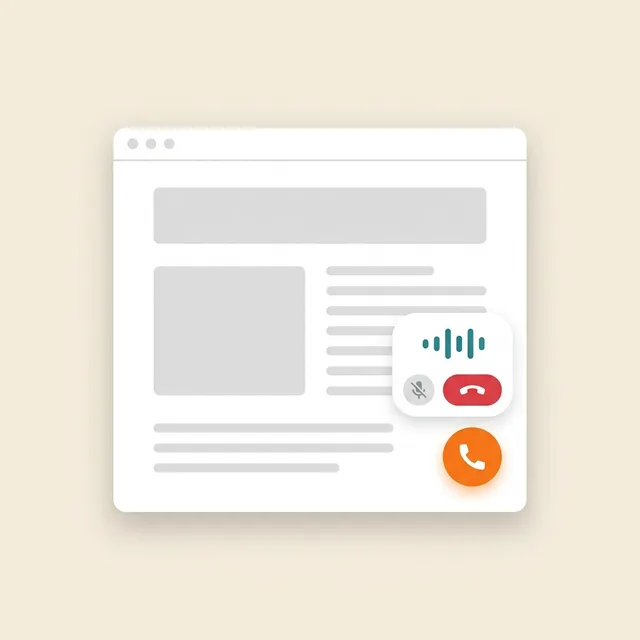
A visitor taps the handset, allows the microphone and talks over the internet. Your Cenaly.com PBX picks the call up as an ordinary inbound one and routes it the way you configured. Built for sites with visitors abroad and questions that are easier to settle by voice.
- No number, no app and no sign-up for the visitor
- Staff take the call the usual way — there is no separate inbox for the widget
- The page doesn’t load the call engine until someone taps the handset
No card · a minute to sign up, another for the tag · settings reach your site in 5 minutes
- for the widget: minutes are billed by your own phone provider
- $0
- to a conversation — no number, no app, no sign-up for the visitor
- 1 tap
- conditions to start: the location’s telephony and the web-call line enabled
- 2
- languages in the call panel: en, ru, ka, tr — the rest fall back to English
- 4
How it works for the visitor
- 1
The visitor taps the handset
They find the button in the corner of the site or as an item in the multi-button fan. There is no number to dial — it isn’t in the interface at all.
- 2
They allow the microphone
The browser asks for the microphone and the visitor confirms. No app, no extension, no sign-up is needed for the call.
- 3
They watch the call connect
The panel walks through clear states: preparing the call, connecting, ringing. After that the visitor hears whatever your PBX is set up to play — a greeting before an operator answers, for instance.
- 4
They talk right in the browser
The panel shows the call status and the “mute” and “hang up” buttons. When the conversation ends, the panel says the call is over.
Set up in three steps
Sign up and add your site
A free Cenaly.com account and your site domain in the "My website" section.
Paste one tag
One line before </body> — in your theme, in a Tilda or Wix HTML block, in Shopify's theme.liquid. It serves every widget.
Switch widgets on in the admin
Each widget is a toggle and a settings form. Changes reach your site without touching code; CDN cache is five minutes.
The tag
<script src="https://cdn.cenaly.com/site/v1.js" data-domain="your-site.com" async></script>One tag for all widgets. `data-domain` is your site; everything else lives in the admin.
What the website call does
Let visitors call without a number
The conversation runs over the internet straight from the browser — no SIP client, extension, install or sign-up. Best on pages people study from a laptop, when the phone is out of reach.
Take it as an ordinary inbound call
The call follows your PBX routing: operators, the queue, a greeting, forwarding, the phone assistant, call recording. The widget has no inbox of its own and doesn’t need one. Best for teams whose routing is already in place and doesn’t need rebuilding.
Open a free call to visitors anywhere
The visitor pays nothing for the conversation — the voice travels over the internet. You pay for it as an ordinary inbound call at your own provider’s rate; $0 per minute from us. Best for businesses with customers abroad, for whom calling is otherwise expensive.
Don’t load the engine up front
The call engine (JsSIP) — the heaviest part — loads as a separate file only after the handset is tapped. Until then the page carries a lightweight button. Best for sites that watch their load speed.
Keep the credentials single-use
For every call the server issues a temporary SIP account: the password lives exactly as long as the conversation, there are no secrets in the widget code and nothing persistent is left with the visitor. Best when the button sits on a public site.
Explain a refusal in plain words
Microphone blocked, the line switched off, telephony unavailable, too many attempts, a network drop — each case has its own message for the visitor. Best for everyone: silence in response to a tap looks like a broken site.
Where it pays off
Customers abroad
Hotels, tours, exports: a visitor from another country speaks to you by voice and pays nothing for an international call.
Visitors on a laptop
Someone is reading your site on a computer with the phone in another room. The button lets them call from the same browser.
Complex services
Repairs, healthcare, legal questions: the visitor wants to check details by voice before choosing a service or leaving an enquiry.
Campaign landing pages
The page already has an enquiry form, but some people prefer to talk: the button lets them call without leaving a number.
A call inside the multi-button
If the site has the multi-button, add the call to its fan: the separate handset goes dark and stops duplicating the same channel.
Enquiries outside working hours
The call follows your PBX route — to a greeting or the phone assistant if you set them up. The widget has no schedule of its own and does not change the route.
How it looks on your site
Colour, position and labels adapt to your site. The widget lives in a Shadow DOM — your styles don't break it, and it doesn't break yours.
On desktop
On mobile
On your side: No phone number is needed and the guest’s phone never rings: the browser connects to your phone system directly, and the call is free for the guest from any country.
On desktop
On mobile
On your side: For your phone system this is an ordinary inbound call: it follows your routing rules instead of landing in a separate widget “operator console”.
Where it goes
Exact menu names and plan requirements, taken from each platform’s own help center.
Sites built with our website builder ship with the widgets already wired — nothing to paste.
Step-by-step guides per platform — in the help center →Pricing
Free
Requires connected telephony
- The widget is free — no limit on calls, websites or staff
- The visitor pays nothing, even from another country: the voice travels over the internet
- You pay your own phone provider as for an ordinary inbound call; $0 per minute from us
- Telephony is not part of the free widget — without it the button doesn’t call
- There is no need for a separate website number — the call goes into your PBX
- We charge nothing per call, per minute, per visitor or per domain — the only bill comes from your phone provider
Why free
Widgets are the door into the Cenaly.com platform: requests, chats and orders from your site land in the same admin as everything else, and some owners later buy extensions. We earn from plans and from four paid add-ons rather than from the widgets — which is why we charge nothing per visitor, impression, request or domain.
With and without
| Without the widget | With the widget | |
|---|---|---|
| How the visitor calls | ✕ The site shows a number: the visitor copies it into a phone and dials by hand | ✓ The visitor taps the handset, allows the microphone and talks from the page |
| Cost for the visitor | ✕ Long-distance and international calls are paid for by the visitor | ✓ The browser call is free for the visitor from any country |
| What staff see | ✕ The inbound call comes from the visitor’s number — which page they were on is unknown | ✓ The same inbound call on your PBX: queue, forwarding, greeting, recording |
| Calling from abroad | ✕ Calling from abroad is expensive, so visitors write more often than they call | ✓ A visitor abroad calls as easily as a local one — over the internet |
| Setup | ✕ A separate call button means its own code on the site and its own terms | ✓ The same “My website” tag and a toggle; no extra code and no extra number |
Honest about the limits
- You need the location’s telephony deployed on Cenaly.com and the web-call line switched on. Without them the button doesn’t call; the widget panel shows both conditions and can switch the line on right there.
- The visitor has to allow the microphone. A microphone blocked by your page’s security policy looks the same to the widget as the visitor declining.
- Visitors can only call you: the browser doesn’t register as a phone and cannot take inbound calls — you can’t ring back into the same tab. For the “call me back” scenario there is a separate callback widget.
- Who answers and what the visitor hears is decided by your PBX. The widget has no schedule of its own: outside working hours the same scenario runs as for a call from a phone.
- One call at a time per open panel. If attempts come too often, the visitor sees “too many calls, please try later”.
- The widget has almost no settings in the dashboard, display conditions included — the button appears on every page carrying the tag, while colour, corner, caption and language are set through tag attributes. To restrict it by page, device or schedule, hide the handset inside the multi-button.
- The call panel is translated into four languages (en, ru, ka, tr) — in other site languages it speaks English.
Who it's for
- Businesses with customers abroad: hotels, tours, exports
- Services where explaining by voice is faster than writing
- Anyone who already has Cenaly.com telephony and routing in place
What a browser call is and when you need one
A browser call is a button on your site that lets a visitor reach you by voice over the internet. They tap the handset and allow the microphone: no dialling, no app to install, no sign-up. The call arrives at your PBX as an ordinary inbound one.
You need it wherever calling is expensive or awkward: a visitor in another country, roaming, a work computer with no phone, a service page where it is simply easier to ask out loud. It differs from a callback in direction: here the visitor calls and talks right away instead of leaving a request to be rung back — and the browser cannot take a return call in the same tab.
The widget is free, but it needs the location’s telephony deployed on Cenaly.com and the web-call line switched on; minutes are billed at your own provider’s rate. Routing, the queue and recording don’t have to change — calls follow the normal route, and the call card, transcript and metrics sit in the Calls section with everything else.
A browser call is the wrong choice if the location's telephony isn't deployed yet, or if your visitors sit in noisy places on poor connections — callback is safer there, since all it asks for is a number. Don't make it your only contact route either: some visitors will refuse microphone access or open the site in a browser that won't grant it, so keep a form or a messenger button next to it.
Questions and answers
What do I need to switch the widget on?
The location’s telephony deployed on Cenaly.com — your own number or a SIP trunk — and the web-call line switched on. The widget panel shows both conditions and lets you enable the line in one click. After that website calls arrive at the same PBX under the same routing rules.
Does the visitor pay for the call?
No, it is free for them from any country: the voice travels over the internet. You pay for it as an inbound call at your own provider’s rate; $0 per minute from us.
Where does the call go, and is it recorded?
To your Cenaly.com PBX as an ordinary inbound call, along the route you configured. If call recording is on, the recording appears in the Calls section with the rest — together with the call card, the transcript and the metrics. The widget has no section of its own.
Can I change how the button looks?
There are no appearance settings in the dashboard for this widget. When you install it as a separate line, the `data-color`, `data-position` (left|right), `data-label` and `data-lang` attributes are available: colour, corner, caption and language. With a caption the round button becomes a pill with text.
Does it work on mobile?
Yes, in mobile browsers with microphone access. On a phone visitors more often prefer an ordinary call, so it makes sense to keep both: the handset in the browser and your number.
Does the visitor need an app or an account?
No. No install, no sign-up, no extensions: one microphone permission. The call credentials are single-use and live only for the duration of the conversation.
What does the visitor see if the microphone is blocked?
A clear message asking them to allow the microphone. There are separate messages for the other cases too: the line is off, telephony is unavailable, too many attempts, a network drop.
How do I install it?
With the shared “My website” tag plus the “Website call” toggle. WordPress — footer.php or a plugin, Tilda — HTML code in head, Shopify — theme.liquid, Webflow — Custom code; Wix and custom-built sites are supported too. The button can be hidden inside the multi-button — which also gives it display conditions.
Will the call button slow my site down?
The button itself is about 24 KB gzipped and arrives with the async attribute after the page has loaded. The call engine — a SIP stack of roughly 71 KB — sits in a separate file and loads ONLY once the visitor taps the handset: someone who never intended to call never downloads it. The browser asks for the microphone at that same moment, not on page load. Button and call panel live in a Shadow DOM.
How much does it cost?
$0 for the widget and $0 per minute from us; there is no add-on to buy. Telephony is not included: you pay for the conversation minutes at its own rate.
What exactly loads on my site?
One loader — about 26 KB gzipped, with the async attribute: it reads which widgets you switched on and pulls only those, as separate files. A widget you left off is never downloaded, and the weight of each one you did switch on is stated on its own page.
Will it break my layout?
No. Widgets render inside a Shadow DOM: your site's CSS doesn't affect them and theirs doesn't leak out.
Which language will the widget speak?
It reads your page's `<html lang>` or a `data-lang` attribute on the tag. Built-in labels are translated into 45 languages — the guest chat covers the same list; your own texts you write in the admin in the languages you need.
Where is the data stored?
In the cloud your account lives in: cenaly.com — AWS, cenaly.ru — Yandex Cloud in Russia. Requests, conversations and bookings stay within the brand's contour.
More — installation per platform, settings and troubleshooting — in the help center. Installation guide →
Works together with
All 12 widgets →Callback
Let visitors request a call: your phone system handles the connection, or you receive the request by email and in your dashboard
Free
Messenger button
One floating button: WhatsApp, Telegram, call, chat — up to 12 channels
Free
Live chat
Live chat with visitors — answered by your staff from the team chat
Free
Switch the button on so visitors call without dialling
Paste the shared tag, switch the widget and the web-call line on — from there the visitor talks to you from the page and the call lands in your PBX.
Start for freeNo card required · Cenaly.com telephony needed · $0 per minute from us